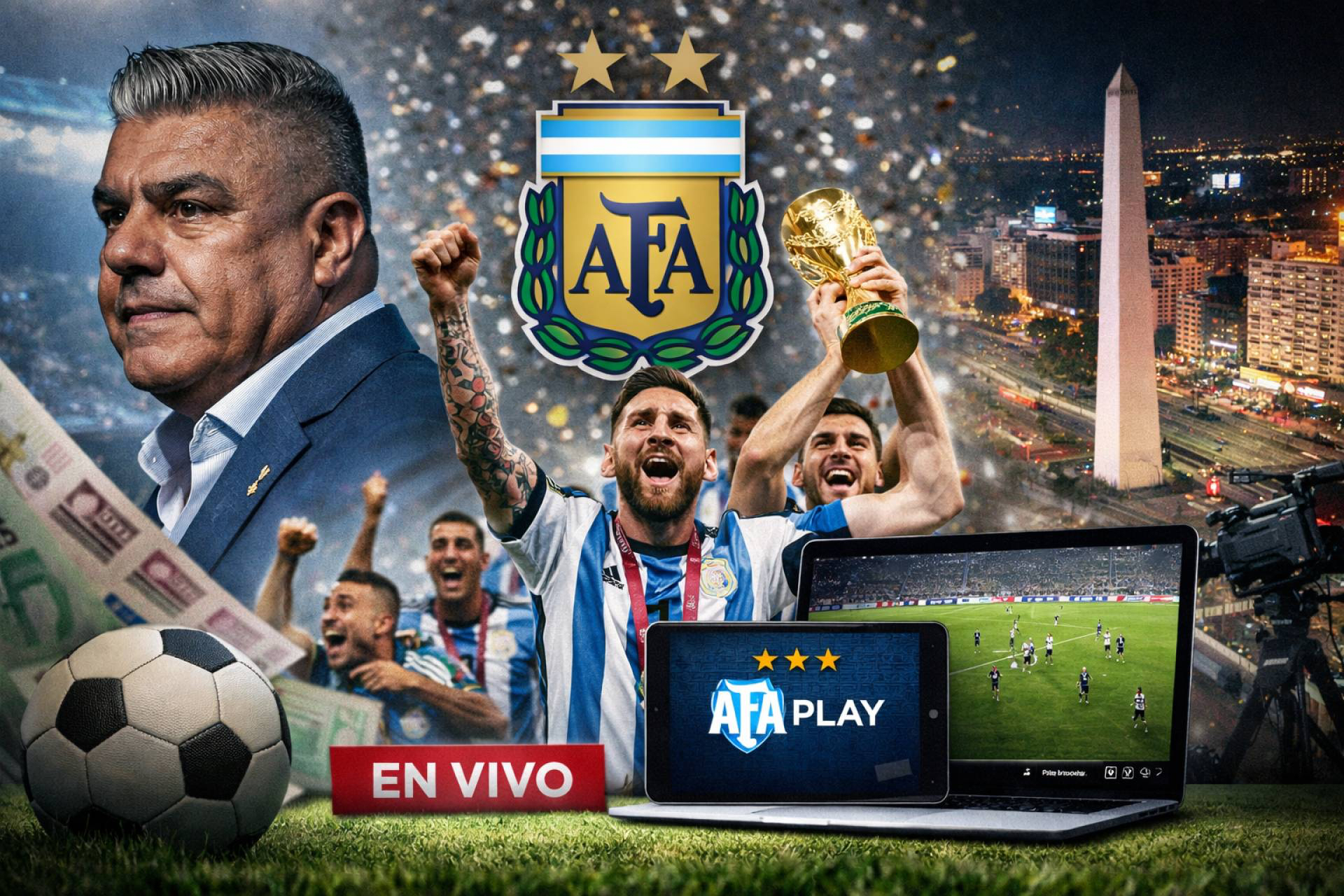
In recent years, the Argentine Football Association (AFA) has undergone a profound transformation: historic titles with the national team, a renewed emphasis on federal football, and a decisive shift in broadcasting strategy. With AFA Play, the governing body has taken direct control of the lower divisions, consolidating a proprietary model aimed at modernizing Argentine football—while triggering growing tensions within the media and commercial landscape.
Over the past several years, the Argentine Football Association has experienced one of the most significant transformations in its recent history. Under a leadership that deliberately broke away from the traditional model, the AFA not only achieved unprecedented sporting success—with the national team winning the World Cup, two Copa América titles, and the Finalissima—but also advanced a broader process of institutional restructuring, financial autonomy, and modernization of the football business.
The creation and expansion of AFA Play, the recovery of competitions, the strengthening of the lower divisions, and the international projection of the AFA brand are all part of a strategic shift that has reshaped the organization’s role both domestically and abroad.
Within this process, Claudio “Chiqui” Tapia consolidated his position as the central political and institutional leader of the AFA. His administration combined firm leadership, strong territorial support, and a clear understanding of the structural power of Argentine football. Alongside him, Pablo Toviggino emerged as his key deputy, playing a central role in coordinating relationships with regional leagues and lower-division clubs—sectors that had long been marginalized in decision-making processes. Together, they promoted an agenda that elevated federal football, strengthened regional leagues, and restored prominence to clubs outside the traditional power centers.
Sporting success played a crucial role in legitimizing this transformation. The national team led by Lionel Scaloni, with Lionel Messi as its global icon, not only returned Argentina to the top of world football but also achieved something rare: uniting the country behind a single symbol. The 2022 World Cup in Qatar, the Copa América titles in 2021 and 2024, and the Finalissima victory over Italy transcended sport, becoming cultural milestones that reinforced national identity and collective pride. This symbolic capital now forms part of the broader institutional project that is contesting power beyond the pitch.
The growth was not merely symbolic. The AFA began to regain control over its most valuable asset: Argentine football as a commercial product. In doing so, it moved toward proprietary models of broadcasting, content distribution, and direct engagement with fans. The decision to invest in AFA Play—initially as a complementary platform and now as a central distribution channel for the lower divisions—marked a break with decades of dependence on media intermediaries that concentrated exposure, revenue, and narrative control.
Beginning in December 2025, the Primera Nacional and Primera B Metropolitana will no longer rely on traditional broadcasters and will instead be transmitted directly through AFA Play. This decision represents more than a technological upgrade; it is a political and economic move that altered the balance of power within Argentine football and exposed a deeper dispute over control of the business.
One of the most significant impacts of AFA Play has been its direct benefit to smaller clubs, which have historically been marginalized in terms of visibility and revenue distribution. The new model guarantees consistent exposure, continuity, and predictability—elements largely absent under the previous system. Clubs are no longer dependent on whether a match is considered commercially attractive. Every team is broadcast, every match is available. For lower-division institutions, where financial stability and sponsorship visibility are critical, the AFA’s proprietary streaming platform represents a tangible opportunity for institutional strengthening and sustainable development.
However, this turning point has also come at a cost. As the AFA reduced the historical control of major media groups over broadcasting rights, a sustained media backlash followed. Persistent criticism, amplified suspicions, and repeated allegations emerged alongside the consolidation of a model that no longer depended on those actors to survive.
The conflict is not purely sporting or communicational. At its core, it is a struggle over who decides what football is shown, how it is distributed, and who captures the economic value it generates. In this context, AFA Play has become the symbol of a leadership that chose to end its reliance on third parties and assert institutional control.
From this perspective, the current conflict surrounding the AFA must be understood not as a series of isolated events, but as a structural clash between two models: one autonomous, associative, and self-managed, and another that for years concentrated strategic decisions outside the field of play. The transformation of the AFA is real, visible, and measurable—and it is also the source of an ongoing battle that now plays out daily in the media.
For more information:
Zona De Gol